THE UNEF WEEKLY
THE SAND DUNE
Page no.01
VOL.VI - NO 43
OCTOBER 26,1962 UNEF HQ.GAZA

Page no.02
| IN THE NEWS
Lt
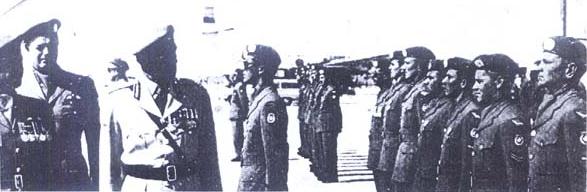
Gen Ps Gyani, Commander UNEF, inspecting the medal presentation parade at
115 ATU(top). Mr.Robert Hausner, CAO, bidding farewell to his predecessor,
Mr. BT Twigt (right). Dr.Ralph Bunche, UN Under Secretary, on board a UNEF
aircraft during his visit to the Force this June (bottom)

|
|

|
Page no.03
RETURN OF A "NATIVE"
|

|
|
Here is a typical Swedish
soldier,fair,tall and robust. Confident,he takes pride in his work
with UNEF, and is glad that he has been able make a small
contribution to the maintenance of peace in this part of the world.
Sven Olof Bengtsson,like many of his colleagues in
the Battalion, has joined more tahn one contingent that served with
UNEF. The fist time he came here was in the spring of 1959 with
Swedish
UNEF Battalion VI. During that six-month period, he served as a
guard in the Headquarters, and also stood sentinel at a tower in
Rafah. His company eas stationed at Camp Valhall, now abandoned
"Why didi you apply for serveci with UNEF ?"
Sven replied: " Initially, it was my longing
for adventure. Of course, the good wages that are paid in UNEF were
enticing. The chance to visit a new part of
the world does the privilege to serve with United Nations in the
cause of peace"
When he returned
home after six months in Gaza, Sven secured a job in the Swedish railroads.
But his longing to return to Gaza was strong."Why did you return?" |
"I liked my work in UNEF. One meets people from different
countries, and there is a fine comradery. I also liked the warm climate of
Gaza as a change from Swedish winters."
The second time Sven was here in the winter of 1960-61,
with the IX Battalion. He kept watch at Armistice Demarcation Line,
equipped with a sub machine-gun, field glasses and a telephone. For one
month he served with the detachment at Sharm el Sheikh.
On return to Sweden he took up a mining job. After a while he
applied for a third term, and succeeded.
Sven´s thied tenure was at the Staff Coy at the Kronor. This time he
was posted in the dog platoon of the Battalion. His job was to look after
and train the ten patrol dogs
Certainly there are very few soldiersin the
Gaza Strip who have such an all-round experience. And he is proud of that
fact.
He definitelylikes his stay with UNEF. Sven spends
his spare time swimming,or playing tennis and chess. Mining still hods
interest for him,and to perfecthis knowledge in the subject, he is
studying chemistry, physics and mathematics. He hopes to enteramining
school back home, and on graduation to become a foreman.
Having served three terms in Gaza, Sven Olof thinks he could retire
from a solfier´s life. The mining jub pulls him back - and so does a
young lady clerk in themining office. Strong ties!
(By the time this article appears in print Sven Olof
would be back in Suweden with the Swedish UN Battalion XV G).
- Lt Siegbahn
Page no.04
FOOD FOR THE FORCE
|

|
|
A
couple of years ago the Canadian Contingent was christened as the “Workhorse
of UNEF Glamour Brigade” by some visiting journalists. The description
was not disputed, but a claim has been put foward by the Indian Army
Service Corps to share the title.
“We
are responsible for feeding the men and machines of the Force”, they say.
And it is true. The 171 Officers and men of the 296 Composite Unit.
commanded by Maj ML Kohli, as part of the IJNEF
Maintenance Area issue rations and POL supplies to the entire Force; and
one of their platoons provides a part of the transport coverage.
Every
morning vehicles from all contingents pull up at the Supply Company
Warehouse at Camp Rafah. They collect fresh food — meat, potatoes,
fruits and vegetables; and thrice a week dry rations.
The
Force eats about 30.000 lbs of food a day - about
five and half pounds per man: 4,000 lbs of potatoes, 3,450 lbs of
vegetabies, 3450 lbs of meat, 2060 lbs of fruit, and sizable amounts of
bread, fruit juice
and other items. About 12,000 eggs are counted each day.
The
issue scales are not uniform, and the items are not the sarne. Indians do
not eat beef, and tbeir food requires a lot of condiments and ghee. Thc
Brazilians like black beans, the Swedes ligonberry and the Danes and
Norwegians rye bread and flour.
The
supplies arrive at Rafah every day from Port Said, Cairo and other places
in UNEF vehicles and railway wagons. They are unloaded at the warehouse,
accounted and stored until issued to units.
|
The
unit also operates an ice cream plant and a bakery. Ice crearn is supplied every
day so that each mess gets it twice a week, and the Unit bakery produces about
2,000 loaves of bread a day for all contingents except the Yugoslav Battalion
and 115 ATU.
The
POL Depot — petrol, oil and lubricants - distributes about 3,000 gallons
of gasoline daily. It arrives from storage depots in Suez by rail and is stored
behind the warehouse, the bulk of it in underground tanks.
For
cooking and operating the generators kerosene and diesel oil are used. The
requirernents of kerosene vary from 700 galions in summer to 2,000 gallons in
winter. About 500 gallons of diesel oil are issued every day. These items are filled in drums and given to the different battalions. The POL depot also keeps
stock of antiseptics and insecticides.
The
Unit’s transport platoon forms part of the UNEF Transport Cornpany. They
mostly operate heavy duty vehicies and provide second line transport required
for the Force. The runs include long convoys to Cairo or Port Said— sometime
to Sharm el Sheikh or shorter trips inside the UNEF operational area, and inside
the camp.
Unlike
the 2 Sikh Battalion from Punjab, the Service Corps soldiers come from all parts
of India. Like other units of the Indian Army contingent -the Medical Team at
Rafah, Signals Section at El Arish and Military Police and Postal Unit at Gaza,
their homes are spread from the southernmost state of Kerala to Punjab in the
north and Bengal in the east. They belong to all religions - Hindus, Sikhs
Moslems and Christians - and have places of worship at Camp Rafah — a Hindu
Tempie, a Sikh Gurdwara, and the two Canadian Chapels for Christians.
A
cosmopolitan crowd themselves the soldiers of the 296 Cornposite Unit find it
easy to mix with people from other contingents. Apart from this, they, due to
the nature of the work, have to operate closely with other contingents.
There
may not be rnuch glamour in their work, but “Workhorses” they are.
Page no.05
DESERT EXPEDITION

The bright
desert sky is alive with shining stars. Below, the Camp Rafah stillness is
sunddenly broken by engines warming up. The time is 4 a.m. The job is a
convoy to Sharm el Sheikh, on the southern tip of the Sinai Peninsula.
A trip that will take us near the most ancient traces of
civilization. And close to where modern-day religion traditionallly began.
It is the start
of oneo many long-distance hauling jobs done by No.56 Canadian Transport
Company, RCASC, forthe UN Emergency Force.
A lot of planning has gone into the desert expedition. For most drivers it
is almost a standard procedure. The 416 miles each way are minor compared
to themonthly unit tally of more than 100.000 miles. But it is a tough,
long grind in hot, humid weather.
There, at the juncture of the Red Sea and Gulf of Aqaba, a small Swedish
guard unit supported by a dozen Canadian Soldiers maintain a watch over
the Straits of Tiran. They observe and report on shipping.
Normally, supplies are flown in by No.115 ATU (RCAF). Our cargo is too
great a quatity for the twice-weekly air run. Our heaviest load is a new
water distillation plant for the Royal Canadian Engineers detachment. It
is to replace one installed by the Bristish Army in 1943.The sappers convert the Red
Sea salty waters to fresh water source at Sharm.
With other
welfare supplies,we are carrying many cases ob beers. A
priceless commodity is one of the loneliest and hottest places on earth.
Some say it is at the end of the world. We agree.
Our convoy
commander, Lt.Gilles Beaulieu, has made a last minute check of men and
vehicles. We have our weapons,mess tins, utensils, sleeping bags, camp
cots, and our water bottles are filled.
Each trunck is
topped up. One vehicle carries 1.000 gallons of gasoline and four
jerricans of motor oil. Desert travel burns up both items.
After giving
final orders,Lt.Beaulieu pulls out in his jepp to lead us. Of six 2½ ton
cargo trucks, one has the distillation plant,two carry gas and oil, two
have canteen stored,and other has our own equipment and pack rations
supllies. The latter vehicle also pulls a heavy water trailer for men and
machines enroute.
Two trucks bring
up the rear. One a ¾ ton power wagon as convoy ambulance.carries a
Norwegian medical assistant and his emergency crash kit. Tailend "Charlie"
is a five ton heavy recorvery vehicle with two RCEME mechanics.
Page no.06
We are on the move. Our headlight ones mix with beams from
guard tower searchlights around camp. The weather is cool. A pleasant wind rustles. through our truck cabs. Each vehicle has
an alternate driver for the
long haul.
After passing the camp gate barrier, we shake down into our
march speed of 35 mph and vehicle tailgate-to-radiator interval of 50 yards.
The desert is quiet. We have nothing to look forward to for
the first hour except barren, flat sand and winding, paved road.
As we near El Arish we pass the darkened Yugoslav Battalion
camp, drive between tall, date palms, and then pass the equally-dark Marina base
housing our fellow-Canadians of No. 115 ATU.
From here it is a straight run to El Qantara and the Suez
Canal. The scenery changes to rolling seas of sand and the sun begins to rise
above the sand-dunes to light the ernptiness of the desert. There is little
vegetation to be seen, but occasionally we can see the Mediterranean Sea on our
right.
At El Qantara we are on schedule. The desert has stirred and
we see heavily-laden camels being led by Bedouins in long white shirts. Tliey
are completely independent people who normally bear allegiance to no man
or flag. But we in the IJNEF seem to have gained some measure of their
friendship.
For centuries they have roamed the desert, seeking pasture
for short periods of time, and building low crescent-shaped dwellings lined with
sheep and goats hair. Theirs is a hard life, but to the Bedouin there is no
other way of life for a man. We wave a friendly greeting.
ONWARD TO SUEZ
On our right merchant ships and oil tankers seem to rise out
of the sand as they wend their wav along the Suez Canal.
We find that the desert is rarely deserted. Now there
are long-haired goats and black sleep being led by black-robed Bedouin women and
scrawny-looking, barefoot children. The Bedouins seem to appear out of nowhere
and then suddenly disappear into no where.
After a couple of cigarette breaks, 10 minutes on the hour
every hour, and with the sun reaching its peak height in the sky, we reach the
outskirts of Suez City and keep on driving. In the distance on our left are a
range of dome-like hills. We are on a flat, sandy plai. Small, thistle-like bushes
dot the landscape. Occasionally there is a lonely, twisted tree.
Heat waves begin to shimmer over the sand. And some of us
begin te see mirages. In the near distance, the tranquility of a deep-blue lake
sheltered by cool green trees. But as we near it,, the deceptive scene disappears
into the yellow sand.
Winds blowing through the cabs are nuw hüt and sandy, and we
can feel the heat from the metal roof. Concentration on driving helps to keep us
from thinking of the scorching sun.
We have been driving along the Gulf of Suez for some time,
and are approaching hilly aid mountainous country. Along the route are a
few oil wells and not far from the road, a few manganese mines.
After 190 miles we reach Abu Zenima, where we are scheduled
to bivouac overnight But in the middle of a hot, sweltering afternoon, Lt Beaulieu decides
to push no. Instead of laying over, we pause long enough te
stretch our legs and eat lunch.
Just 20 miles inland at Sarabit el Kadim the site of ancient
turquoise mines, have been found probably the oldest alphabetic
inscriptions ever found. The writings, carved in stone, now in the Cairo Museum, date from about 1850 BC.
Also between here and the desolated town of El Tor, 65
miles ahead of us, around deserted copper mines, are traces of Egyptian settlements
dating back to 3000 BC.
At El Tor we pause briefly and then begin the last few hours
of the outward trip. It is still daylight as we wind our way up through limestone-hills
and mountains. We pass through canyons that seem similar to the
US Grand Canyon.
- About 30 miles east as the
crow flies, and much longer and torturous by vehicle, lies Mount Sinai the
traditional site where Moses received the Ten Commandments — source of
the Christian, Moslen and Jewish faiths. Jebel Musa (Mount of Moses) is a
peak over 7,000 feet high, lying in the middle of massive red range of
grafite and sandstone. At it foot stands St. Catherine’s Monastery, built
on the site of the Burning Bush (Exodus 3:2-5) in 520 AD by the Byzantine
Emperor Justinian, and since continuously occupied by Christian monks.
Periodically,
we reach the Gulf of Suez shores. And
then we resume an uphill climb into a second belt of mountains as the sun goes
down and the sky darkens. The road is narrow and serpentine, a series of gradual “S” curves, as it
reaches high above
the valley. On the way downhill we have rounded the tip of the Sinai. In the
eerie, failing light we see a mixture of valleys, and cut, scarred and barren
ground that must be like the surface of the moon.
Then as we pass by relics of the 1956 IsraelEgypt war,
smashed and burned trucks, carriers and guns, we sight our objective. Ahead are
the series of isolated buildings that make up the Sharm el Sheikh outpost.
The end of our outward trip. We quickly park vehicles, shed
clothes and head for Shark Bay to wash away the dirt, grime and sweat. The trip
has taken 15 hours of almost steady driving. Feeling cleaner, we gulp down a
late dinner and put to bed our tired frames.
Before heading back we have a two-day layover. The first is
taken up swimming in crystal-clear waters, waLking on a shell-laden beach and
whiling away hours watching the splendid array of fishhuge starfish, slim
needlefish, spectacular tuna and thousands of fry.
Our second day, a bonus because we didn’t bivouac overnight
enroute, is a tour to Ras Nasrani, about 15 miles away through more strange,
fascinating country. There, at a lonely observation post
we take turns scanning the Gulf of Aqaba and Strait of Tiran through powerful
mounted binoculars.
The straits are narrow and shipping is forced, by coral reefs
and a broken ship, to move through a channel near the post.
Nearby are abandoned minefields, coastal gun emplacements,
and broken tanks, vehicle and trenches. Fierce rocks jut up out of the ground
as hills and mountains of changing colours to form a picturesque backdrop.
But our visit is over and now we must start our return
expedition. We have driven through mach of the 24,000 square mile Sinai
Peninsula, but have had little time to tour the historic sights.
Perhaps another day. It is said that that which is here today,
was here yesterday and will still be here tomorrow.
Capt.O'Regan
Page no.07
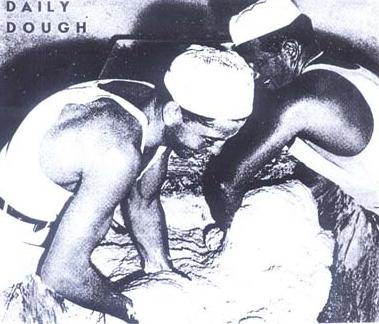
DAILY DOUGH
- Nestling at a corner in "Litle
Yugoslavia" in El Arish, at the foot of a sandy hillock, is a newly
constructed " T " shaped barrack. On both sides of its lowly, white
walls are written in bold painted letters," The IX Rotation of the Yugoslav
Contingent". The roof cover shines int the sun. Huge branches of an old
arish tree, convered with dust,.bend over it.
- It was around noon when I entered
the barrack, unnoticed by its four busy occupants: Privates Matija Hus, Petar
Robman, Drago Culibrk and Petar Mihajlovic - all dressed in vests, trousers and
white caps.
- Robman, Culibrk and Mihajlovic were
leaning over a large board - which served as a coverof a still larger kneading
trough. Culibrk was weighing pieces of dough, using a small scale. Robman and
Mihajlovic were mixing water with flour, preparing loaves of bread. Hus was
sitting at a small table next to the wall, putting the weighed loaves into small
cotton bags and lining them up in wooden troughs.
- Silence. Only a dull thud of the
falling dough on the plank was heard. Their faces were covered with sweat.
- "This is the last one",
said Hus.
- Then,
they all stopped work, as if they heard a command.
- "Finished
for the day ? " , I interrupted.
-
"Of mixing flour - yes " - answered all of them smiling, and hurried
towards the door.
- The
room was empty. Only huge wooden troughs were standing empty in the middle.
Traces of dough could be seen everywhere. two large wooden troughs full of
loaves of bread were placed against the wall. A few sacks of flour were seen on
the side of the troughs.
- I
followed them to the next room. Hus took out a packet of cigarettes and
offered one to me. We were smoking. Then the Company Commander Maj Mojic and the
private on duty at the bakery, Mladen pajcic appeared at the door.
-
"How are you boys". asked the Major.
-
"As usual, answered Hus,the foreman
-
"As you see, each day is the same here", said Maj Mojic. "Every
morning, the four of them start work at five and continue till noon, often
longer. They do not stop until bread for the whole contingent is ready".
-
"It isthe same every day, mixing, mixing, mixing..." Mihajlovic
silently complained.
- "Shame
on you", said Hus. "How would you feel about digging a trech, for
instance, for a 120 mm heavy gun ? "
- "How?
... Tell me,how many times you have to dig a trech for a gun ?" continued
Mihajlovic.
- Oh,
forget about it, Robman said and moved towards the bakery. Others followed him.
As they approached the white bakery one opened the iron door, and others pulled
out a plate with 64 loaves of baked bread.
-
"In a few minutes another 64 loaves will be ready", said Hus.
- "And,
then, itwill be finished for the day", sighed Mihajlovic.
-
"No", snapped Hus.
- "Yes,
your are right. We have to feed our friends", agreed Mihajlovic.
- Their
friends are three pigeons, two dogs, a cat and a cock. Each day, after finishing
the work, they visit them - dressed in white - and feed them.
- As I
came out of the bakery, Maj Mojic said: " Wonderful men, they are ! It has
nvery happened once that the bread was not ready, or not baked enough. Never,
You all know it as well I do, for you eat it every day. And something else: all
the menbers of the other contingents know about the quality of the brad they
make".
- "
Don' t you agree ? ".
SAVO KASCHELAN
Page no.08
SAT SRI AKAL

- In a two weeks’ time the 2nd Battalion of the Sikh Regiment, commanded by Lt
Col DN Kamran, will be sailing for India. For the tall, tough, bearded Sikh soldier another opportunity may not come to visit Middle East, to wear the blue turban, or to serve under the flag of the United Nations. Those privileges will belong to his brethren in otber battalions of the Indian
Army.Sikh
- However, 1962 will long be remembered as the year in Deir
el Ballah. And the Sikh solder will be looking back with pride at the year he spent as part of
UNEF.
- It all started in the middle of last year when the
Force Headquarters were told that a Sikh battalion was coming to replace the 4 Rajputs. The first problem that confronted UNEF was to provide enough turbans for them. Orders were placed to18,000 yards of blue muslin. This, it was calculated, would provide three turbans for every Sikh
soldier.
- In November the battalion arrived, and the barber at Deir
el Ballah packed his equipment and departed. The Sikhs do not shave or cut their hair, thus the Procurement section promptiy terminated the hair-cutter’s contract.
Palestinians in Deir el Ballah were surprised when the Sikh
soldiers did not retrun the friendly greeting of “Ram Ram”, but said “Sat Sri Akal”.•
Questions were asked why he grew his beard, did not cut his hair, wore a turban, what does
Sikhism mean, and so on.
- Religious teachers may have written expositions, but to a common farmer from India who has taken the
olive green as his profession, ]t was not easy to explain to questioners.
- —“Sikh”, he would say, is one who learns. The
beard and the turban are part of his religion. In fact the Sikhs are distinguished by the “Five
Ks”. Kesh— not to cut the hair or beard; Kungha — to carry a comb in the hair; Kuchha — to wear a pair of
shorts; Kara — to carry a steel bangle on the right wrist; and to bear a Kirpan, or a sword. And his religion is
known as the Khalsa.
- Sikhs have been great fighters for ages. This has been partly due to the fact that they come from an area which lies across the invasion routes to the heartland of India. The Sikh had always to fight to survive. Soldiering became his second nature. Even
now, among the male offsprings in a famiiy, one tills the farm, while the rest of them generally join the Army. A
soldier has an important status among the Sikhs.
- The Sikhs impressed all by their smart bearing and discipline. The quarter guard of the battalion at Deir
el Ballah became a show piece with smartly turned out soldiers in white anklets clicking to attention whenever a UNEF
vehicle passes by. The blue berets were replaced by blue turbans along the ADL. The local children learned “Sat Sri Akal”, and the crisp military salute. The ice was
broken.
- A demonstration of military discipline was shown at their inaugural parade in January. This
was soon followed by the spectacuLar celebrations of “Tofrek Day” — the battle honour day of 2nd Battalion of the Sikh Regiment. The Searchlight Tattoo and display on stilts which was held on the
latter occasion, would. long be remembered.
- Soon after settling down at Deir el Ballah, the Sikhs were seen running
along the ADL, in the camps or jumping and tugging at ropes. Are they mad? Why do they not rest? The questions
soon found an answer when the semi-annual athletics were held. The Sikhs carried away
almost all the trophies, and established new records in most of the events. As they return to India, it is only a few sports events that they have left untouched, and haven’t won or established a new
record.
- The Sikhs — like others in the Indian Army
- are professional soldiers. The keynote in building up a good Army, the Indian Officers would
explain, is constant training. Besides military training which is imparted regularly, sports constitute an important part in the life of a soldier. Besidcs, it keeps him fit and occupied. And no wonder the Sikhs won most of the prizes in
sports.
- The Sikhs themselves have learned many things during their stay with UNEF; about the different peoples with whom they have worked and lived, and about the problems
of the people of this country. They return home with a better perspective of the events happening in the
world.
- They have made many friends. The presents they have received from colleagues of other
countries will be proud possessions. In the archives of the Battalion the flags of the various UNEF contingents and the trophies and tokens of affection received during their stay here will be displayed with
pride and honour.
- Again, for the first time in the history of the Battalion they have.
gone abroad not to fight a war, but to work in the cause of peace. A rare privilege
indeed.
- And the soldiers had a good time here. They enjoyed their stay in the leave centres in Beirut and Cairo, and the more fortunate ones their visits to Europe and England. The Sikh band, which has
lent colour to many functions in the Force, visited Britain to take part in the Edinburgh tattoo, and won a good name for
itself.
- As the Sikhs sail for India, we would say “Sat
Sri Akal ”. OBSERVER
-

-
Page no.09
A DANE DEBATES
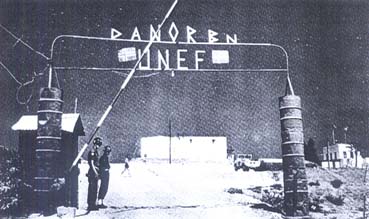
- The Gate of DANOR Battalion
|
Nearly
six years have elapsed since the establishment of UNEF. A unique organization,
it is compused of soldiers from many parts of the world. A synthesis have been
achieved. The
force is a busy organization, as can he seen from white painted vehicles moving
all day long along of streets of Gaza,or the Caribou with bold UN making flying
across the sky. They, however, do not give one a correct picture of the mature
of the work of the organization.
The
real work is done along the Armistice Demarcation Line, at the lonely
Observation Posts that dot it along its length.
There the blue bereted soldiers stand sentiinel alert all the time,
keeping a watchful eye on the frontier
Luckily,
peace has been prevailing here for
a long time. There are few incidents. Ocasionally a bedowin strays across the
ADL, or
|
|
a shepherd crosses it to
bring back the sheep. But , the soldier at the Observation Post has to be
careful not to overlook such violations, for these small incidents may flare up
and attain serious proportions.
The
work is tendious, and the weather is not too good. For Dane, who is not used to
tropical climates, it is not easy to suffer the hot sun beating on the
shimmering sand.
Then,
why does the Dane volunteer to come here ? Why does he, us many do, opt for
another term ? An arbitrarily chosen soldier says: “ I wanted to start a
buseness back home. I Wanted money for that, and by serving with the UNEF, there
can be quite a saving, Also, before settling in life, I wanted to travel and see
the world.
As
a matter of fact, the ideals of United
Nations , the work of UNEF, do not
enter a soldier´s
|
|
mind when he
volunteers.
But soon aflter landing in the Strip, he becomes consious oh the proiblems of
the area. The Political situation in the Middle East, and its impact on the
events happening iin the world, become clearer. He soon has undertanding of the
significant role of UNEF. – and begins to take pride in his work.
That
makes the tendious duty at the ADL aceptable to the soldier.
But
everything ins not tendious. There is a lot of adventure. He meets people from
other countries, visits various places of interest, like Cairo, Luxor, Beirut
– and Jerusalem, to visit whick place every Cristian is anxiouns.
And no less an experience
is his stay in Gaza, among people who belong to a different milieu.
(
Sand Dune )
|
Page no.10
- THE PLANE
-
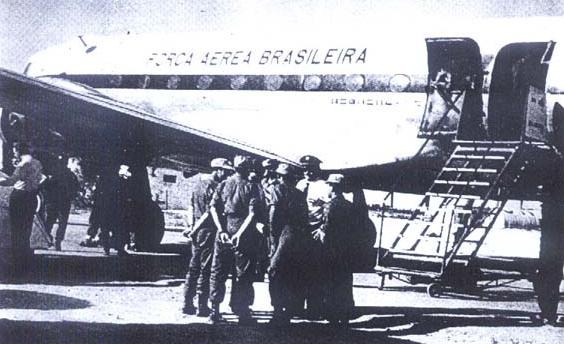
- BRAZILIAN AIR FORCE
-
-
“FAB 2045 cleared to take off...”
-
- The
message f rom the centrol tower comes jn strong and clear through the
pilot’s earphones. As he increases engine speed, the propellers bite
into the air and pull the large C-54 aircraft onto the take off
runway at the Galeao Military Air Base in Rio de Janeiro.
- Minutes
Iater, tracing a smooth curve in the dark sky, the big four engined
plane bears towards Recife, its first stop on the trip to El Arish, in
the Middle East.
- It is an
aircraft of tbe Braziflian Air Force (BAF), which departs regularly from
Brazil each month, carrying to fellow-countrymen on duty with UNEF
messages from their families and small gifts.
- “The
Plane”- hasan affectionate place in the Brazil Battalion. And is a
great morale-booster for the soldiers.
- In spite
of the fact that they could regularly correspond with their near and
dear ones, a small parcel received through the plane has a special
meaning to whorn it is addressed.
- A pair of
woollen socks or gloves made by the mother, wife cr sweetheart acquires
a value, hard to explain. A piece of home-made candy brings to the
Middle East the simple, yet special, flavour of things back home. Of
small material value, they are “valuable” and make the plane
expected and welcome.
- It’s so popular that the
plane serves as a calender for the troops “Two planes more — and 1
will be home...”
-
Landing
in the desert airstrip at El Arish, plane and crew are welcomed by
speciafly assigned men from the Battahon. The Movernent Control
detachment at El Arish gives them technical assistance.
- At “Bathalao
Suez” the crew is warmly received by men, anxious for news from home.
- “How’s
Rio... ?“ “...and how’s the football
chainpionship going on ?"
- Very often
pilots have been personal friends of the soldiers who wear the Blue Beret.
More questions follow:
- “...so
my Junior is walking?”
- The talk
goes on till the night is old. The crew and their friends chat and chat,
about things at home and in the Middle East.
- With the
confident feeling that they are the link between the soldiers and their
homes, the plane crew leaves El Arish with words for many a soldier’s
family — and the heartfelt thanks from the bluebereted Brazllian
boys.
- “When
is the next plane ?“
- OF SADNESS, AND CHEER
 |
|
-
-
-
There is a room at ythe
UNEF Hospital in Camp Rafah that is set apart from the ordinary
sick-bed wards. And it holds a special place in
the hearts of the Norwegian ofíicers and men who administer to the
health needs of UNEF.
- It
is a room of dadness and a room of good cheer. And it takes
many litte things as well as time and patience to look after the
physical and mental needs of its occupants. For the room does have
patients, patients who soon learn to smile again as their bodies
mend and become filled out from tasty and nourishing food.
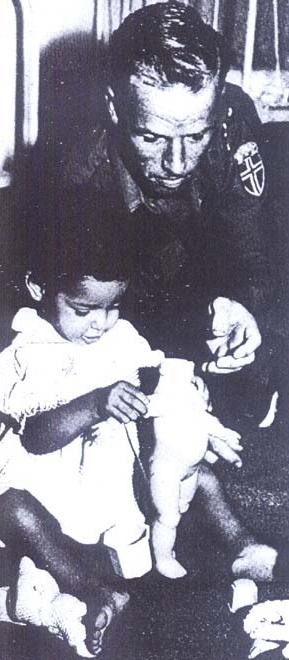
- It is a room
with chalk, crayon and grease pencil drawing on its otherwise
starkly bare walls. And amidst the many small beds, dark curlyhaired
children crawl and play. For this is the room where from day to day,
and week to week small Bedouin youngsters recover from injuries and
malnutrition.
- Among the
occupants of the room are twe little girls who have become the
sweethearts of the hospital. They have been patients for some four
months and are not yet fully recovered. Both girls were given typical
Norwegian names, Laura and Signe, by the former CO Lt. Col. R.
Nordlie.
- SLOW RECOVERY
- Laura, when she was
admitted to the hospital, was very much undernourished and had an
unbelievably low blood count of between 20 and 30 percent. She had
to be fed by the doctors intravenuously until sufficient strength
was restored for normal feeding.
- Today she is
in good condition but her Bedouin parents have asked that she be
kept at the hospital a little longer. They and the Norwegian staff
are afraid of returning her to the desert, where the RCD Recce
Squadron picked her up, as it would perhaps be only a question of
time before anemia and malnutrition again took its toll from her
frail body.
- Signe has
suffered the most pain of the two. Doctors are amazed that she is
slowly recovering as she suffered the most terrible wounds that they
have ever had to treat. Only a very small child, Signe had been
playing as all children do when she suddenly tripped and stumbled into
a roaring fire. The severest burns were on the stomach and chest, but
her face, arms and hands were also affected. After much patience and
medication, the doctors were successful in stopping infection, and she
has had many operations to transplant healthy skin to where the
parched and burned layers once lay. Doctors are now confident that she
will recover.
- Although the
hospital personnel and other patients in a way adore the small ones
from the Sinai, there is no doubt that the greatest love, affection
and respect is reserved for little Signe who has lain so admirably
calm for many months.
- Soon the
children will be receiving clothes and comforts from Norwegian
voluntary organizations who have heard of their plight.
|
Page no.12
THE LARGEST
"CONTINGENT"

- Contingents
may come and contingents may go, but they go on for ever. And, in a sense,
they are the largest contingent in the UNEF the locally employed civilians.
-
There are nearly 1,700 local civilian employees serving with the Force —
in Gaza, Rafah and El Arish. They are
employed in various capacities, from. watchman or labourer to clerk or
accountant.
-
Many of them have been with the UNEF from the time it landed in Abu Suweir.
They moved with it to El Arish, Rafah and finally to Gaza. They have seen
many a rotation, but they themselves have never rotated.
- Members of
this ‘contingent’ have been recruited
locally. They are paid on a daily or monthly basis. Nearly half of them
are unskilled or semiskilled such as watchmen, labourers and cooks. Many
of them are skilled in various trades — drivers,
mechanics to name only a few. Others serve in the administrative
departments of the Force, where they are employed as translators, clerks,
technical assistants and storekeepers.
-
Their knowledge of the local languages and familiarity with the area has
helped considerably in the functioning of the Force. Those. employed in administration
have developed a better knowledge of English. Many of them speak and write
French —which has been, to a very
large extent, the language in which the people of the area conducted their
business. Consequently some of them have been selected to join the UN
operations in the Congo, the ntimber being nearly 25.
- The majority
of the local employees are refugees. Those recruited in IsmaiLia and Cairo
have brought their families to Caza, and have settled here. Their children
go to local schools, run by the government and the UNRWA.
- Their social
life centres round the CRC the Civilian Recreation Club —
situated in one of the local “villas”. There they gather in the
evenings, see films or play indoor games. Twice a month parties are
arranged, which compare well to those held in UNEF messes. During summer
they have trips to the beach, or other places of interest in the Gaza Strip.
- It is true
that the local civilian employees do not belong to the military or
international cotnponent of the UNEF. However, they have, and are, making
a significant contribution towards its functioning.
- Page no.13
-
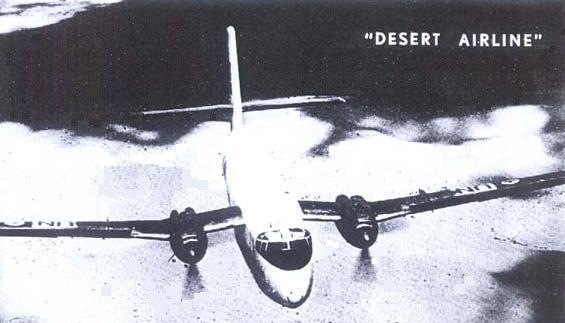
DESERT AIRLINE
-
-
- Aircraft of No. 115 ATU (RCAF) may not have the most comfortable passenger
seats, but without a doubt they are among the most-worked flying machines. And
the men who operate them for UNEF are
second
to none in skill and devotiontoduty.
-
The 90-man unit helps to remove a sense of isolation for grateful UNEF menbers
by providing a link with neighbouring
countries. The three hightailed
Caribou transport aircraft, with their prominent UN markings on a field of white,
are seldom airborne without carrying a fuil load of UN personnel, maul freight
and baggage. They have a normal carrying capacity of 18,70O pounds of cargo or
28 passengers.
-
An
airline and freight seivice from El Arish and Gaza to Cairo, Beirut , Port Said
and Jerusalem, is combined with a ferry service that takes troops, mail and supplies
from_ and to such isolated Sinal desert outposts as El Quesima, El Kuntilla, Ras
el Naqb and Sharm el Sheikh.
-
Although
logistical support is the largest task, the unit’s operationa1 - role as the
aerial eyes of UNEF along the IF is no less important. Two single-engine Otter
aircraft, cruising at 100 knots an hour, are used to scan the barren Sinai wastelands
in support of ground reconnaissance troops.
-
On
the shuttle service from the Mediterranean to the Red Sea, north to. Beirut and
southwest to Cairo, the seven pilots in the unit turn in about 200 hours flying
time: monthiy, and an average of more than 900 nautical miles daily. From April
to June this year, statistics show cargoes of more than 230 tons of freight, 42
tons of mail, an equal amount of baggage, and 1,858 passengers.
-
Middle
East flying is much different from fiying in Canada, but new piiots quickly
adapt themselves to the sameness of the desert and its lack of prominent landmarks.
They must fiy corridors and must not pass over Israel. Their approach chart
warns them to beware of camels and goats on the runway. And they find shimmering
heat waves, caused by sand-reflected heat, make Otter landings difficult.
-
For
every hour of flight, the wear and tear of desert flying requires 10 hours of
aircraft maintenance. Powdery sand infiltrates bearings and must be washed out
weekly, heat and gravel quickly wears out tires, damages propellers tips,
removes paint from fuselage and wing undersurfaces, and gravel propelled by the
slipstream cracks starboard side windows.
-
To
keep the aircraft serviceable, there are 55 ground crew personnel representing
nine trades and skills. Made up into three maintenance crews, they work in
shifts in a iarge cantilever hangar built by RCE sappers. During busy periods
the tradesrnen work round the clock. Every 100 hours fiying time means a
three-day inspection, and a major weekiong inspection is made after 800 hours
of flight. At each 1,000 hours, a complete engine overhaul is done and new propellers instailed.
-
With
such a heavy workload, and a main supply base 7,000 miles away in Canada, the
unit has to stock a large amount of spare parts to keep aircraft serviceable, about 6,000 different
items. Major replacements held here are two complete Caribou
engines and one Otter engine. A small metal repair workshop turns out pieces of
fuselage “skins” and other minor metal work.
-
The
unit’s work is international and in itself it is partly international, being
supported by several other UNEF units. A Yugoslav guard company is attached,
Indian Army signallers look after landline communications and Canadian soldiers
operate VHF ground to air communications equipment, provide engineer services
and do movement control and postal work.
-
No.
115 ATU (RCAF) by its efficiency senso
of duty, and enviable safety record, stands out as an integral part of a pioneer
force.
Page no.14

Page no.15

- Band Major Gurdial Singh of 2nd Battalion os the
Sikh REgiment leading the Battalion Band at a UNEF function. The Band
achieved international fame this year when it participated in the recent
Edinburgh Tattoo.
*********************************************
Our Cover:
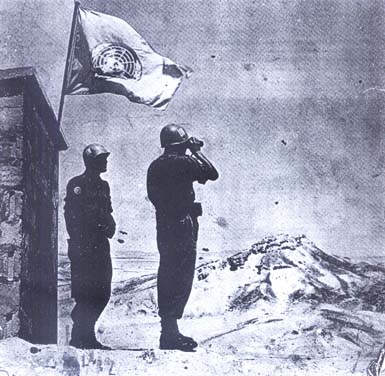
Sentinel of Peace - Yugoslav soldiers at
the Observation Post in El Quesima, along the International Frontier.
Photografh by Sgt.Gord Groucher, Canadian
Public Relations DEtachment.
Photograhs on pages 9 and 15 are by Hrant
Studios, Gaza.
THE SAND DUNE is published on
Fridays at the Office os Public Information, HQ. UNEF Gaza.
Editorial Staff: I.Ramamohan Rao
(Editor): Grujo Zlvkovic. Public Information Officer:O.Dich
VOLTAR